
Diesel injection pumps
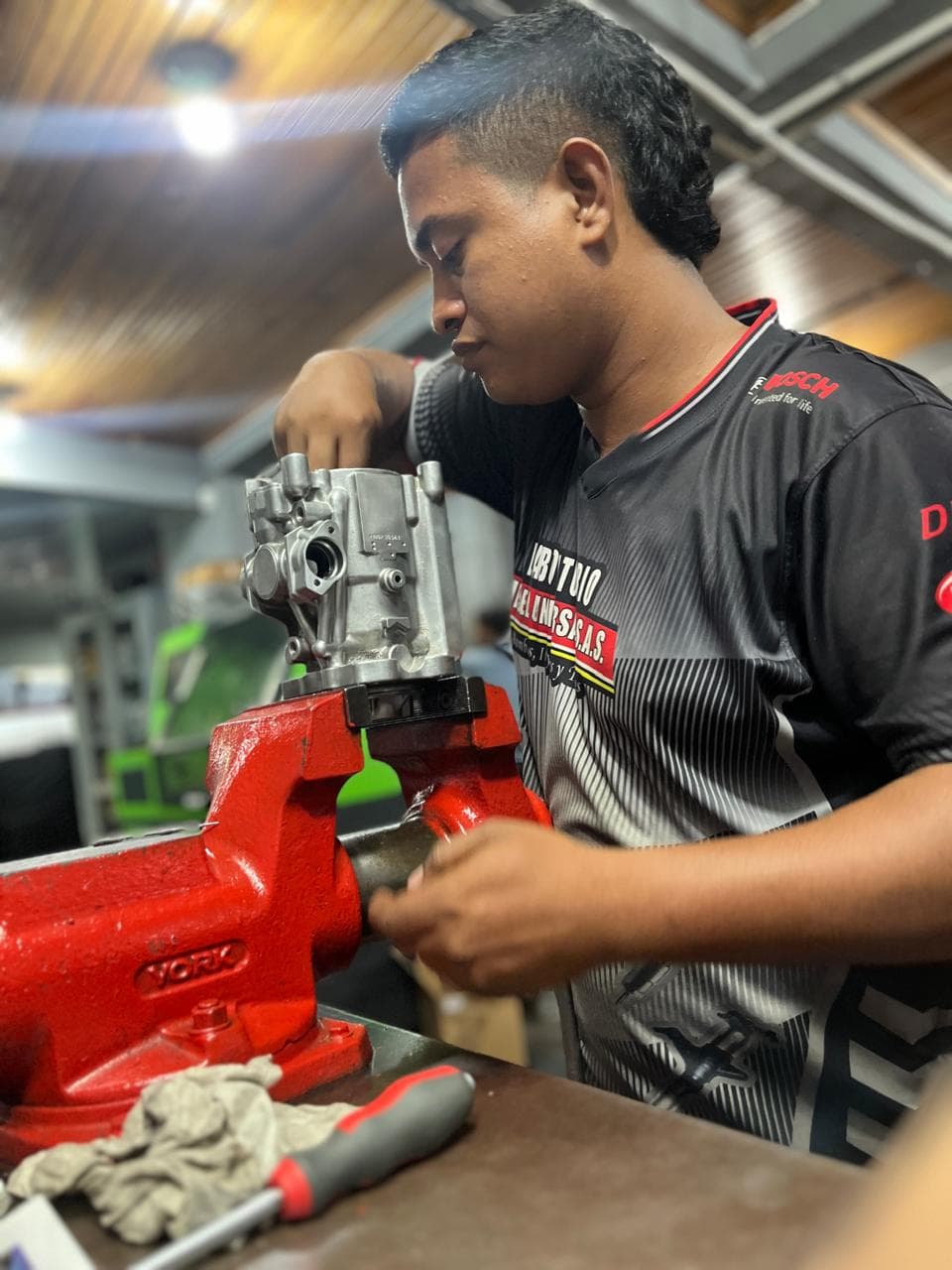
The injection pump delivers fuel to the injectors at the right pressure, volume and timing. At the laboratory in Barrancabermeja, Colombia, rotary, in-line and Common Rail high-pressure pumps are diagnosed, repaired and calibrated.
Technical guide
What it is and how it works
What an injection pump is
The injection pump is the part of a diesel fuel system that pressurizes fuel and sends it to the injectors. A diesel engine has no spark plugs to ignite the mixture: the air is compressed so much that it becomes very hot, and fuel is injected at the end of that compression, where it ignites on its own. For this to happen cleanly, fuel must arrive at high pressure and at exactly the right instant.
That makes the pump one of the most demanding components in the engine. Its parts work with clearances measured in microns, lubricated by the fuel itself, so any wear or contamination shows up as power loss, smoke or hard starting.
Types of pumps
Rotary pumps use a single pumping element and a rotating distributor that sends fuel to each cylinder. They are compact and were widely used in light diesel vehicles and pickups for decades. In-line pumps have one plunger and barrel for every engine cylinder and are associated with heavier duty applications such as trucks, buses and machinery.
In Common Rail systems the pump has a different role: it only generates the high pressure that is stored in the rail. The decision of when and how much to inject is made by the ECU through the injectors. Other variants include electronically controlled pumps and unit injectors, which build the pump into each injector.
How a pump is calibrated
A pump cannot be judged by eye. It is mounted on a test bench that spins it at different speeds and measures how much fuel it delivers per element, what pressure it reaches, when delivery starts (timing) and at what speed the governor cuts off. These values are compared with the manufacturer's specification for that part number.
If the values are outside tolerance, the pump is disassembled, worn components (seals, valves, elements, kits) are replaced and the pump is adjusted again until the measurements match the data sheet. A final bench test confirms the result.
Maintenance and common causes of failure
The most common cause of injection pump damage is contaminated fuel: water removes lubrication and causes wear and corrosion, while particles scratch precision surfaces. Replacing filters at the recommended intervals and draining the water separator is the maintenance that most extends pump life.
Other causes include long-term use of poor quality fuel, running with very little fuel in the tank (the pump draws air and loses cooling) and normal wear after many kilometers of service.
Symptoms
Signs that the part may be failing
- The engine loses power or stumbles when accelerating
- Excessive black or white smoke
- Hard starting when cold or hot
- Fuel leaks at the pump
- Higher fuel consumption than usual
Diagnosis
Common symptoms and their probable cause
This table is a guide. The real cause is confirmed with the part on the test bench.
At the laboratory
What is measured
- Delivery volume per element or cylinder
- Supply or transfer pressure
- Injection timing
- Internal sealing and pressure
- Governor cut-off by speed
- Maximum pressure and regulation (Common Rail high pressure)
Scope
What is serviced
- Rotary pumps
- In-line pumps
- Common Rail high-pressure pumps
- Calibration on a test bench
- Replacement of kits, seals and valves
- Rotary pumps
- In-line pumps
- Common Rail high pressure
- Bosch · Denso · Delphi · Zexel · Siemens
Process
How the work is done
Reception and diagnosis
The pump is inspected and its condition recorded before any work begins.
Disassembly and repair
Worn parts are replaced and the assembly is cleaned.
Bench calibration
Delivery volume, pressure and timing are tested with electronic equipment.
Delivery with report
The pump is returned tested, with the measured results.
Is the part in another city in Colombia? It can be sent by courier. When writing on WhatsApp, packing and shipping instructions are provided.
Frequently asked questions
What does a diesel injection pump do?+
It takes fuel at low pressure, compresses it and delivers it to each injector at the right moment and in the right amount. In mechanical pumps it also adjusts injection timing according to engine speed and load.
What is the difference between a rotary and an in-line pump?+
A rotary pump has a single pumping element and a distributor that sends fuel to each cylinder. An in-line pump has one pumping element per cylinder and is generally more robust, which is why it is common in larger engines.
Can pumps from trucks and heavy machinery be repaired?+
Yes. The laboratory works with pumps from light vehicles, heavy vehicles and industrial diesel machinery.
Can a pump be sent from another city in Colombia?+
Yes. Parts are received by courier from anywhere in Colombia. A message on WhatsApp is enough to get packing and shipping instructions.
Contact
Questions about parts and services.
Replies include the diagnosis and the cost of the work. The fastest channel is WhatsApp.
Message on WhatsApp- Phone
- +57 315 852 4324
- dieselunivers@hotmail.com
- Workshop
- Av. 36 #31-07, Zona Industrial, Barrancabermeja, Santander