Diesel Cranks But Won't Start: What to Check
If your diesel cranks but won't fire, the fault is usually fuel, air in the lines, injection pressure or preheating. A check in the right order.
By Diesel Universal technical team
4 min read
In this article
- What does it mean when a diesel cranks but doesn't start?
- In what order should you check it?
- 1. Fuel in the tank and filter
- 2. Air in the lines
- 3. Injection pressure
- 4. Preheating
- 5. Sensors and ECU
- Which checks are cheap and which need a scanner or a bench?
- Common mistakes
- When is it the pump or the injectors?
Quick answer
A diesel that cranks normally but won't fire is missing fuel, injection pressure or heat. Check the fuel level, filter and water separator first, then look for air in the lines, then injection pressure (rail pressure on Common Rail), then preheating when cold, and finally crankshaft or camshaft sensors with a scan tool.
When a diesel cranks normally but won't fire, you have already ruled out the simple things: the battery and starter do their job. What is missing is one of the three things combustion needs: fuel, pressure or heat.
What does it mean when a diesel cranks but doesn't start?
The engine turns at its normal speed, so the electrical side is fine, but no combustion follows. For a diesel to fire it needs clean fuel arriving at the injectors, enough injection pressure, compression, and, in cold weather, preheating. Anything that interrupts one of those, or stops the ECU from commanding injection, gives this symptom.
In what order should you check it?
| What you observe | Likely cause |
|---|---|
| Starts after several tries or with the hand primer | Air in the lines, saturated filter |
| Starts and dies after a few seconds | Insufficient supply, rail pressure, sensors |
| Won't fire and no smoke | No fuel or no injection pressure |
| Fires only with help when cold | Glow plugs, battery |
| After a filter change or running out of fuel | Air in the system, needs bleeding |
Starts after several tries or with the hand primer
- Likely cause
- Air in the lines, saturated filter
Starts and dies after a few seconds
- Likely cause
- Insufficient supply, rail pressure, sensors
Won't fire and no smoke
- Likely cause
- No fuel or no injection pressure
Fires only with help when cold
- Likely cause
- Glow plugs, battery
After a filter change or running out of fuel
- Likely cause
- Air in the system, needs bleeding
1. Fuel in the tank and filter
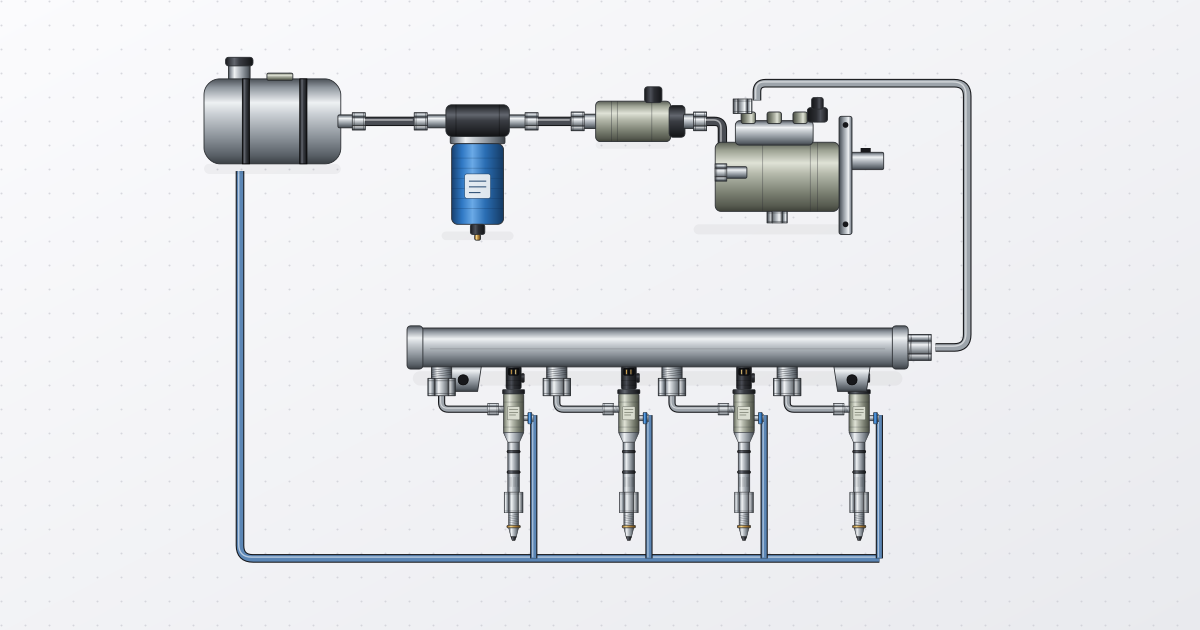
It sounds obvious, but the gauge can lie. Confirm there is fuel and check the filter and water separator: a saturated or water-filled filter is one of the most frequent causes. See how often to change the fuel filter and water in diesel fuel. Normal: the separator bowl holds clean fuel with no water layer. Abnormal: a visible water layer, a cloudy bowl or a filter that is heavy with debris.
2. Air in the lines
A loose fitting, a cracked hose or a badly done filter change lets air in. Air compresses instead of pushing fuel, so the engine won't fire. It is solved by bleeding the system, covered in how to bleed a diesel fuel system. If air keeps coming back after bleeding, there is a leak on the suction side that must be found.
3. Injection pressure
On Common Rail systems the ECU won't allow injection until rail pressure reaches a minimum while cranking. If pressure doesn't rise, the engine cranks without firing. Typical causes:
- Injectors with excessive return flow, which leak pressure away.
- A worn high-pressure pump.
- A faulty pressure regulator or rail pressure sensor.
You check it by reading rail pressure with a scan tool while cranking and by measuring injector return. The pressure the system must reach is a manufacturer specification, so compare against it rather than a general number. More in what is a Common Rail system. On a mechanical pump engine the equivalent checks are fuel reaching the pump, a working stop solenoid and correct pump timing.
4. Preheating
When cold, glow plugs that don't heat make the engine crank without firing. See glow plugs and diesel won't start in cold weather.
5. Sensors and ECU
A faulty crankshaft or camshaft position sensor can stop the ECU from knowing engine position, so it doesn't inject. An immobilizer can also block starting. A scan tool is the key instrument here: no engine speed signal while cranking, or a stored security fault, points straight at this step. See how to use an OBD2 scanner on a diesel.
Which checks are cheap and which need a scanner or a bench?
Cheap: fuel level, separator, filter, visible leaks and a quick bleed. Scanner: rail pressure while cranking, engine speed signal, stored codes and immobilizer status. Bench: injector return flow and high-pressure pump output, measured against the manufacturer specification.
Common mistakes
- Replacing the high-pressure pump before checking filter, air and sensors.
- Cranking for long periods, which drains the battery and heats the starter.
- Spraying starting fluid into the intake.
- Assuming a good battery means the fault is in the starter, when the engine is in fact turning fine.
When is it the pump or the injectors?
If fuel is clean, there is no air, preheating works and the engine still won't fire, the likely cause is in the injection system. A scan-tool diagnosis and bench tests of the pump and injectors show which one is at fault; see bad diesel injector symptoms. For the full list of causes, see why a diesel won't start.
Key points
- If the engine cranks strongly and won't fire, the battery and starter are not the problem: fuel, pressure or heat is missing.
- The most common causes are a saturated filter, air in the lines, water in the fuel and low rail pressure.
- On Common Rail, the ECU won't inject until rail pressure reaches a minimum; reading it with a scan tool gives the answer.
- Checking in order saves time and avoids replacing the pump or injectors unnecessarily.
Frequently asked questions
What does it mean when a diesel cranks but doesn't start?
The engine turns normally but combustion doesn't happen. It needs clean fuel, injection pressure, compression and, when cold, preheating.
Could it be the fuel filter?
Yes, it is one of the most common causes. A saturated or water-filled filter restricts flow and the engine doesn't get the fuel it needs.
How do I know if there is air in the system?
It often starts after several tries or with the hand primer, and may stall after a few seconds. It also happens after running out of fuel or changing the filter.
When is it the high-pressure pump?
When the battery, fuel, air and preheating are fine and rail pressure doesn't rise while cranking. A scan tool reading and a bench test confirm it.
Keep reading
Diagnostics4 min read
How to Test Diesel Injectors Without Removing Them
Tests you can run on a diesel injector without removing it: scan tool, per-cylinder corrections, return flow and listening, and when a bench test is needed.
Diagnostics4 min read
Diesel Won't Start in Cold Weather: Causes
Why a diesel engine won't start or cranks slowly when cold: glow plugs, battery, fuel and compression, with a step-by-step check in the order worth doing it.
Diagnostics10 min read
Diesel Rough Idle: Causes, Checks and Fixes
Diesel shaking, hunting or stalling at idle? Find out whether it is air in the fuel, one weak injector, EGR or a mount, with checks in the right order.