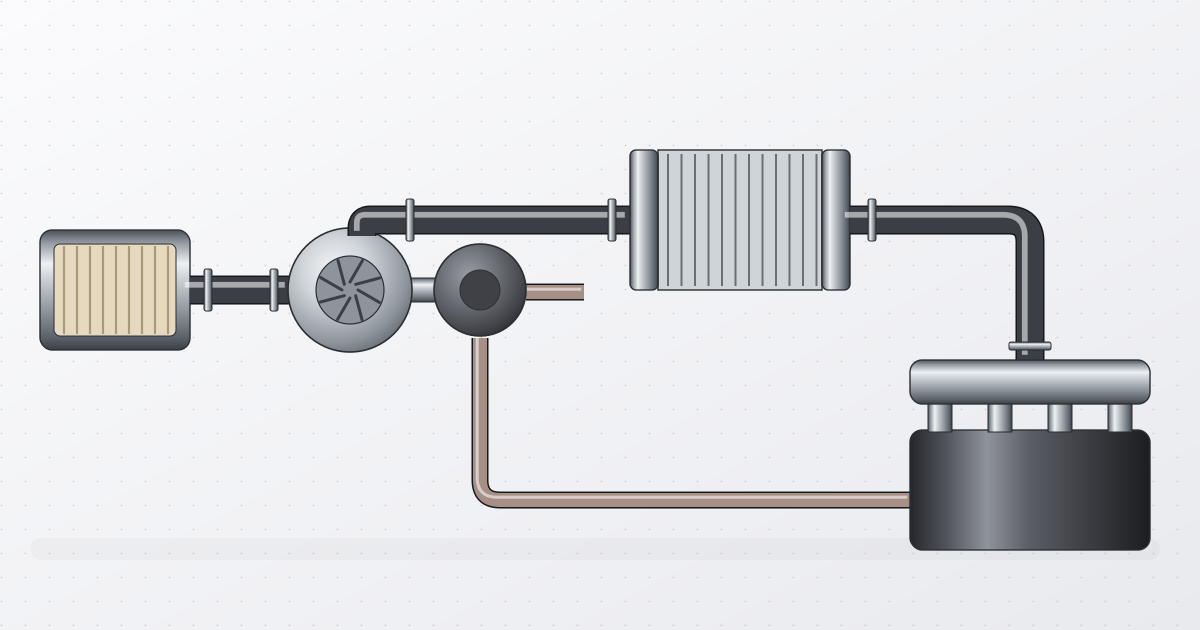
Black Smoke When Accelerating in a Diesel
Why a diesel engine blows black smoke when accelerating: air filter, injectors, turbo, EGR or sensors. What to check first and when it is serious.
By Diesel Universal technical team
4 min read
In this article
- Is a little black smoke when accelerating normal?
- What are the most common causes of black smoke on acceleration?
- What should you check first, and in what order?
- 1. Air filter and intake
- 2. Turbo and pipes
- 3. Injectors
- 4. EGR, sensors and DPF
- Does the fuel system type change the diagnosis?
- Common mistakes
- Black smoke or another color?
Quick answer
Black smoke when a diesel accelerates means fuel is not burning completely: either the engine gets too little air or it receives too much or badly sprayed fuel. Check the air filter and intake first, then the turbo and its pipes, then the injectors, and use a scan tool for the EGR, air flow sensor and DPF.
Black smoke in a diesel means one thing: incomplete combustion. There is more fuel than the available air can burn, or the fuel isn't atomizing well. When it appears on acceleration, the engine is asking for more fuel and something in the intake or the injection isn't keeping up.
Is a little black smoke when accelerating normal?
Sometimes. Many diesels, especially older mechanical-pump engines and heavily loaded trucks, show a brief light puff under hard throttle, because air arrives a moment after the fuel. What is not normal is smoke that is dense, appears at light throttle, repeats every time, or comes with power loss, a whistle, jerking or a warning light.
| Result | What it suggests |
|---|---|
| Brief, thin puff at full throttle that clears at once | Usually within normal behavior for that engine |
| Dense cloud on every acceleration | Air shortage or too much fuel; start the checks below |
| Constant smoke, even at steady speed | Injectors or a fuel-control fault more likely than air |
Brief, thin puff at full throttle that clears at once
- What it suggests
- Usually within normal behavior for that engine
Dense cloud on every acceleration
- What it suggests
- Air shortage or too much fuel; start the checks below
Constant smoke, even at steady speed
- What it suggests
- Injectors or a fuel-control fault more likely than air
What are the most common causes of black smoke on acceleration?
| Cause | How it shows | What to do |
|---|---|---|
| Dirty air filter | Smoke on acceleration, power loss | Inspect or replace the filter |
| Injectors with poor spray | Smoke, rough idle, higher consumption | Diagnosis and bench test |
| Leaking or damaged turbo | Whistle, lack of boost, smoke under load | Check pipes and turbo |
| Clogged EGR valve | Smoke, hesitation, check-engine light | Clean or replace |
| Air flow meter or sensors | Smoke with a warning light, uneven power | Scan-tool reading |
| Saturated DPF | Smoke, frequent regenerations | DPF diagnosis |
Dirty air filter
- How it shows
- Smoke on acceleration, power loss
- What to do
- Inspect or replace the filter
Injectors with poor spray
- How it shows
- Smoke, rough idle, higher consumption
- What to do
- Diagnosis and bench test
Leaking or damaged turbo
- How it shows
- Whistle, lack of boost, smoke under load
- What to do
- Check pipes and turbo
Clogged EGR valve
- How it shows
- Smoke, hesitation, check-engine light
- What to do
- Clean or replace
Air flow meter or sensors
- How it shows
- Smoke with a warning light, uneven power
- What to do
- Scan-tool reading
Saturated DPF
- How it shows
- Smoke, frequent regenerations
- What to do
- DPF diagnosis
What should you check first, and in what order?
Go from the cheapest, quickest check to the ones that need a scanner or a bench.
1. Air filter and intake
This is the quickest. A clogged filter, a loose intake pipe or a leak between the filter and the turbo reduces air. Before suspecting expensive parts, check this. A normal filter lets light through when held up to a lamp; one packed with dirt, oil or water does not.
2. Turbo and pipes
If the turbo doesn't build the right boost, the engine gets less air than it needs on acceleration and blows black smoke. Look for oil or soot streaks on the intercooler hoses, loose clamps, split hoses and play in the turbo shaft. More in diesel turbo failure symptoms.
3. Injectors
Dirty or worn injectors spray badly and leave fuel unburned. If the smoke is constant, with vibration or high consumption, this is the most likely cause. It is confirmed by reading per-cylinder corrections and a bench test. See bad diesel injector symptoms and how to test injectors without removing them.
4. EGR, sensors and DPF
A clogged EGR feeds exhaust into the intake and leans out the air supply; a faulty air flow meter misleads the ECU. A scan tool shows live data: compare the measured air against what the engine should be taking in, and check for stored codes. See diesel EGR valve problems, what is a DPF and how to use an OBD2 scanner on a diesel.
Does the fuel system type change the diagnosis?
Yes. On a mechanical pump engine, smoke often points to a worn injector, a pump set to deliver too much fuel, or a restricted air path, and there is little electronics to hide it. On a Common Rail engine the ECU limits fuel using the air flow signal, so a failed sensor or a boost leak can cause smoke and a warning at the same time. In both cases the manufacturer specification is the reference, not a general rule of thumb.
Common mistakes
- Cleaning or replacing the DPF or EGR first, when the smoke is a symptom of an upstream fault.
- Replacing injectors without reading corrections or testing them.
- Using additives as the only fix.
- Ignoring a small boost leak because the engine still seems to run fine.
Black smoke or another color?
The color points to the cause: black is poorly burned fuel, white can be water or unburned fuel, and blue is oil. To compare, read black, white and blue smoke in a diesel. If you also notice weak power, see diesel engine loss of power.
Key points
- Black smoke is fuel that isn't burning properly: there is too much fuel or too little air.
- The most common causes are a dirty air filter, injectors with poor spray, a leaking turbo and a clogged EGR.
- If it only shows on hard acceleration, check intake air and the turbo first; if it is constant, check the injectors.
- A little smoke at full throttle can be normal on some engines; dense, repeated smoke is not.
Frequently asked questions
Why does my diesel blow black smoke when I accelerate?
Because fuel isn't burning completely. Most often there is too little air (dirty filter, leaking turbo) or too much or badly sprayed fuel (injectors).
Is black smoke serious?
It signals poor combustion that, if it continues, fouls the engine, EGR and DPF and raises consumption. It should be diagnosed.
Could it be the air filter?
Yes, it's the first and cheapest thing to check. A clogged filter limits air while the engine keeps injecting the same fuel.
Can I keep driving with black smoke?
If it's light, briefly yes, but don't ignore it. If there is power loss, jerking or warning lights, check it now.
Keep reading
Diagnostics10 min read
Diesel Rough Idle: Causes, Checks and Fixes
Diesel shaking, hunting or stalling at idle? Find out whether it is air in the fuel, one weak injector, EGR or a mount, with checks in the right order.
Diagnostics7 min read
Diesel Engine Knocking Noise: Causes and What Is Serious
Why a diesel engine knocks: what clatter is normal, which noises point to injectors, fuel or worn parts, how to check them, and when to shut the engine off.
Diagnostics9 min read
Diesel Loss of Power: Causes, Limp Mode and Checks
Diesel losing power, in limp mode or no boost? Causes in order: air filter, boost leaks, turbo, fuel supply, injectors, EGR and DPF, and how to check them.